03Chapter 3 · the main chapter
Get Up to Sleep: The Night, Step by Step
Answers the question: "If I can't sleep, I get up. Then what?"
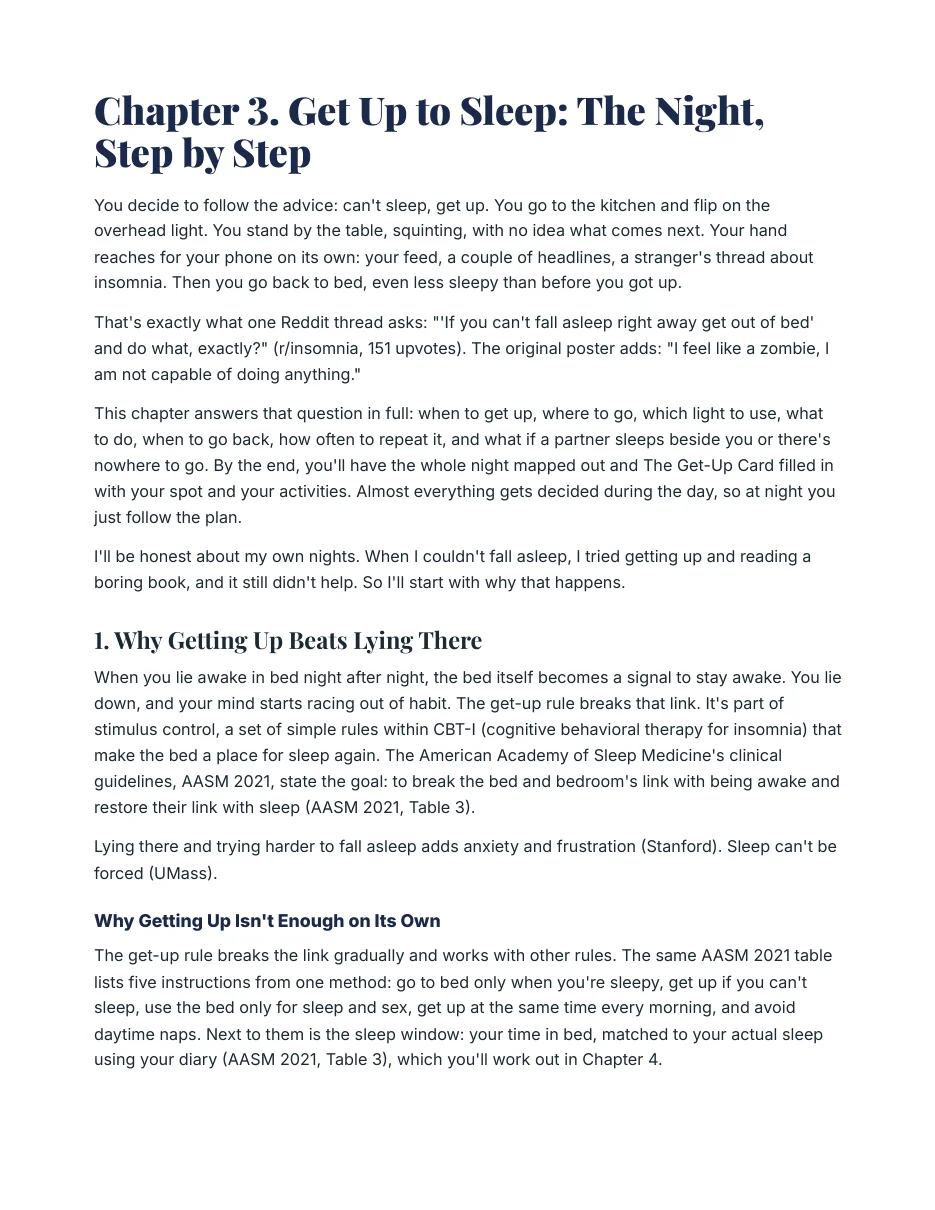
You get up as advised, switch on the bright kitchen light, grab your phone, and go back to bed more awake. This is the book's main chapter. After many hours of lying awake, the bed itself becomes a signal to stay awake, and the chapter walks you through what to do instead of lying there.
What's inside
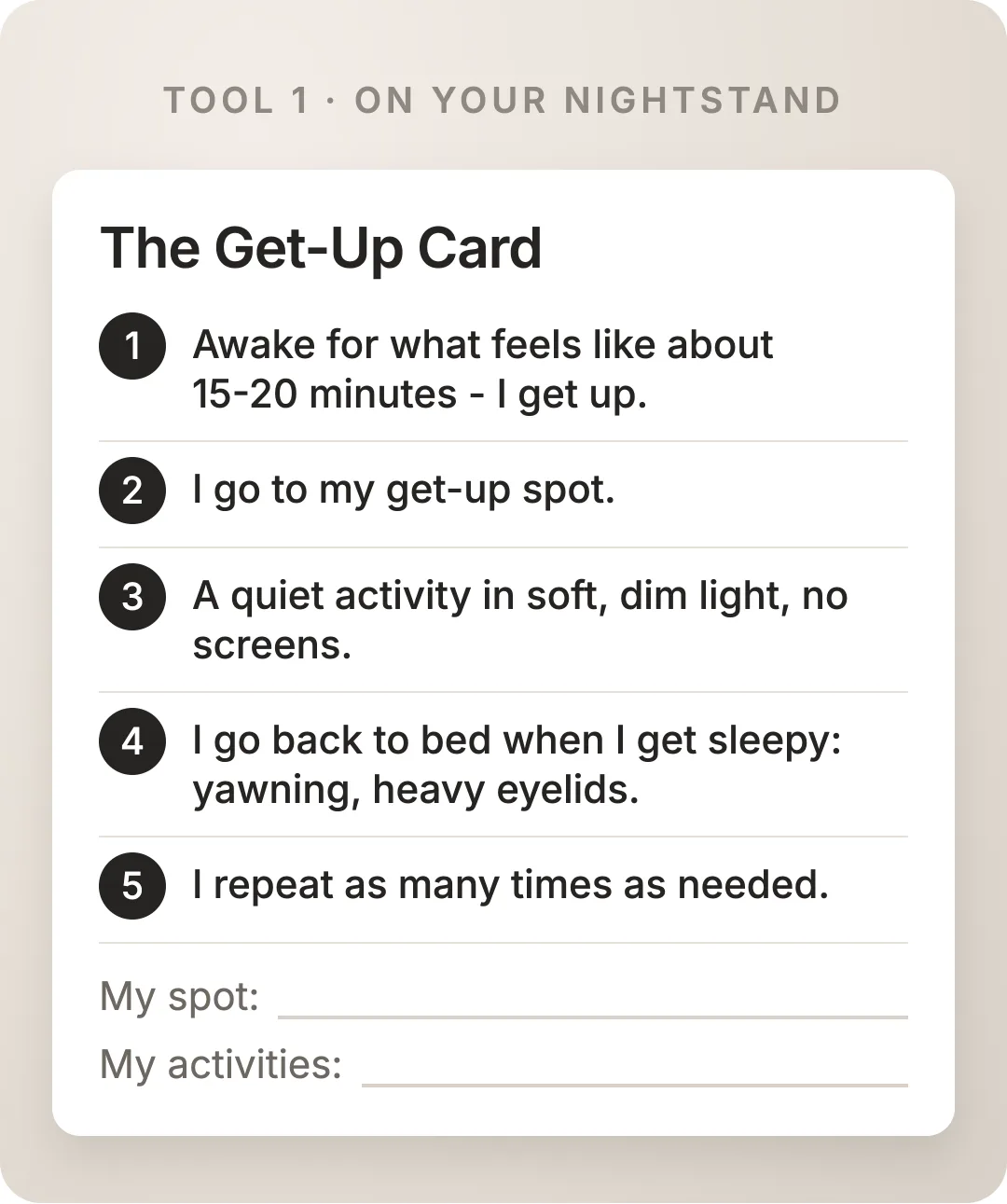
When to get up: after what feels like about 15-20 minutes, without looking at the clock.
Where to go: a spot outside the bedroom, set up the evening before, and a warm blanket by the bed. Why it's fine to sit on the couch, but not to fall asleep on it.
What light: soft and dim, no screens, and why a paper book beats a glowing one.
What to do: a "works / doesn't work" list and four features of a good nighttime activity.
When to go back: yawning and heavy eyelids. How sleepiness differs from tiredness, the key idea for "tired all day, wired at night."
11pm and 3am: two short plans side by side, and what to do if you wake toward morning.
If your partner sleeps next to you or you have nowhere to go: how to warn your partner ahead of time about night get-ups, and the "half an hour, half an hour" option for a single room.
Questions You Might Have Here: "I got up five times in one night. Is that normal?", "It's cold, and I don't want to get up", "Can I listen to a podcast?", "I didn't fall asleep at all until morning".
What you'll have after it: you know the whole night step by step: when to get up, where to go, what light, what to do, when and how to go back. Your card is filled in with your spot and your activities.
If you buy the book for one chapter, make it this one.
04Chapter 4
Your Anchor and Your Sleep Window
Answers the question: "How long should I stay in bed, and when should I get up?"
"I'll catch up on Saturday," "I'll go to bed early to make up for it": the most natural moves, and exactly what keeps the loop going. This chapter replaces scattered rules with a system. In clinical programs a specialist sets the sleep window; the book uses a gentler version with a lower limit and safety checks.
What's inside
Your anchor, a fixed wake-up time: the same time 7 days a week, give or take half an hour at most, even after a bad night. How to pick it based on the mornings when you have to be up.
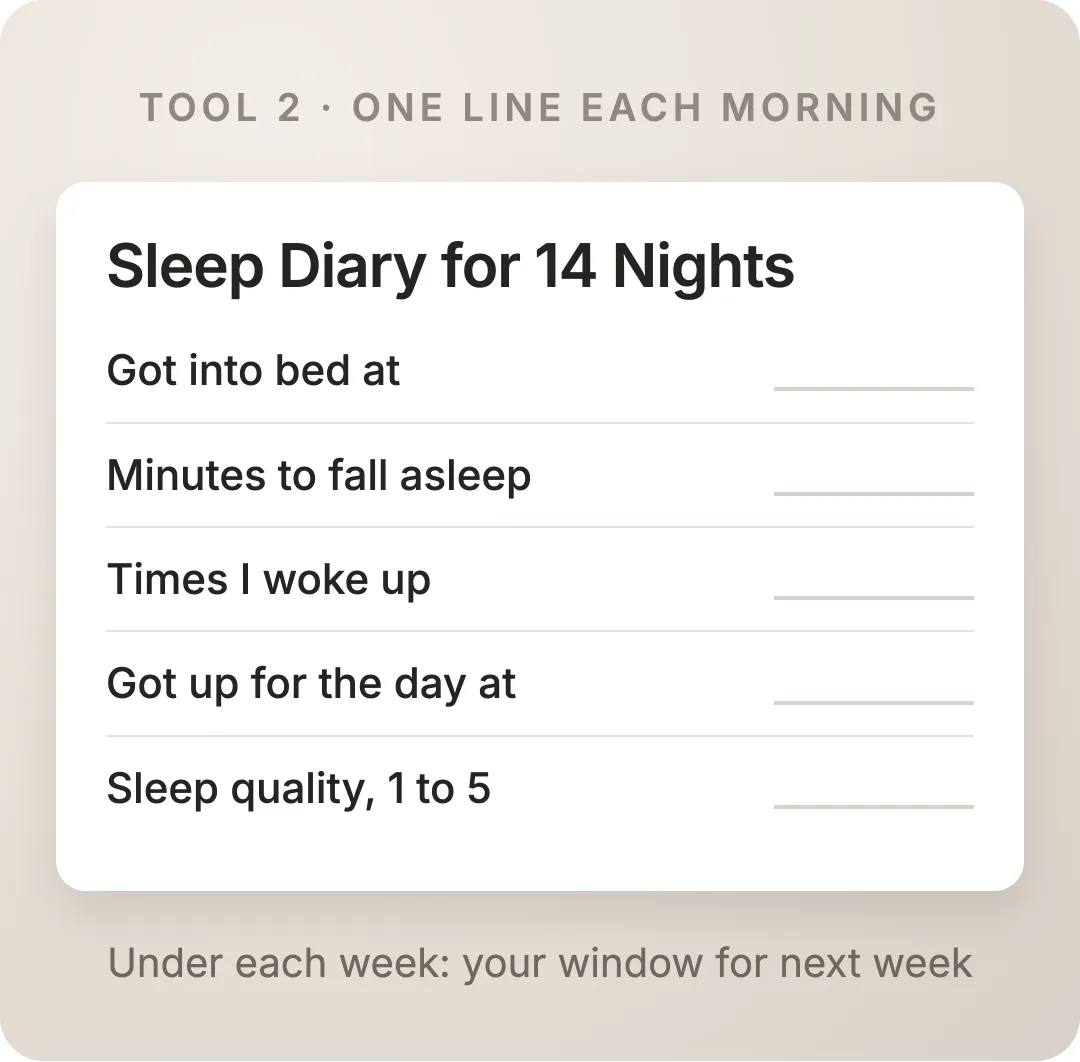
The sleep diary: one line each morning, modeled on the Consensus Sleep Diary. Rough estimates are fine, and no clock-watching at night.
Your own numbers: sleep time, time in bed, and sleep efficiency, with a worked example.
The sleep window in week two: your average sleep plus at most an hour, but never under 5.5 hours.
Safety checks before the window: driving or operating machinery for work, a tendency toward mania, poorly controlled seizures, marked daytime sleepiness.
What to expect in the first weeks: daytime tiredness, named in advance, and a plan for the hard days.
Adjusting the window once a week in weeks 3-6, using a simple rule.
The morning after a bad night, and weekends: a protocol with no sleeping in.
What you'll have after it: a fixed wake-up time, and by week two a sleep window calculated from your diary, or a decision to set it with your doctor. Plus the adjustment rule and a plan for the morning after a bad night.
A fixed wake-up time may already be on your list. A sleep window from your own diary is the other half of the same system.
05Chapter 5
When Your Head Won't Switch Off
Answers the question: "What do I do with a head that won't switch off?"
"Tired all day, wired at night": your body is tired, your mind isn't. This chapter works on your mind and your sleep schedule together: on their own, techniques for a racing mind have no guideline recommendation.
What's inside
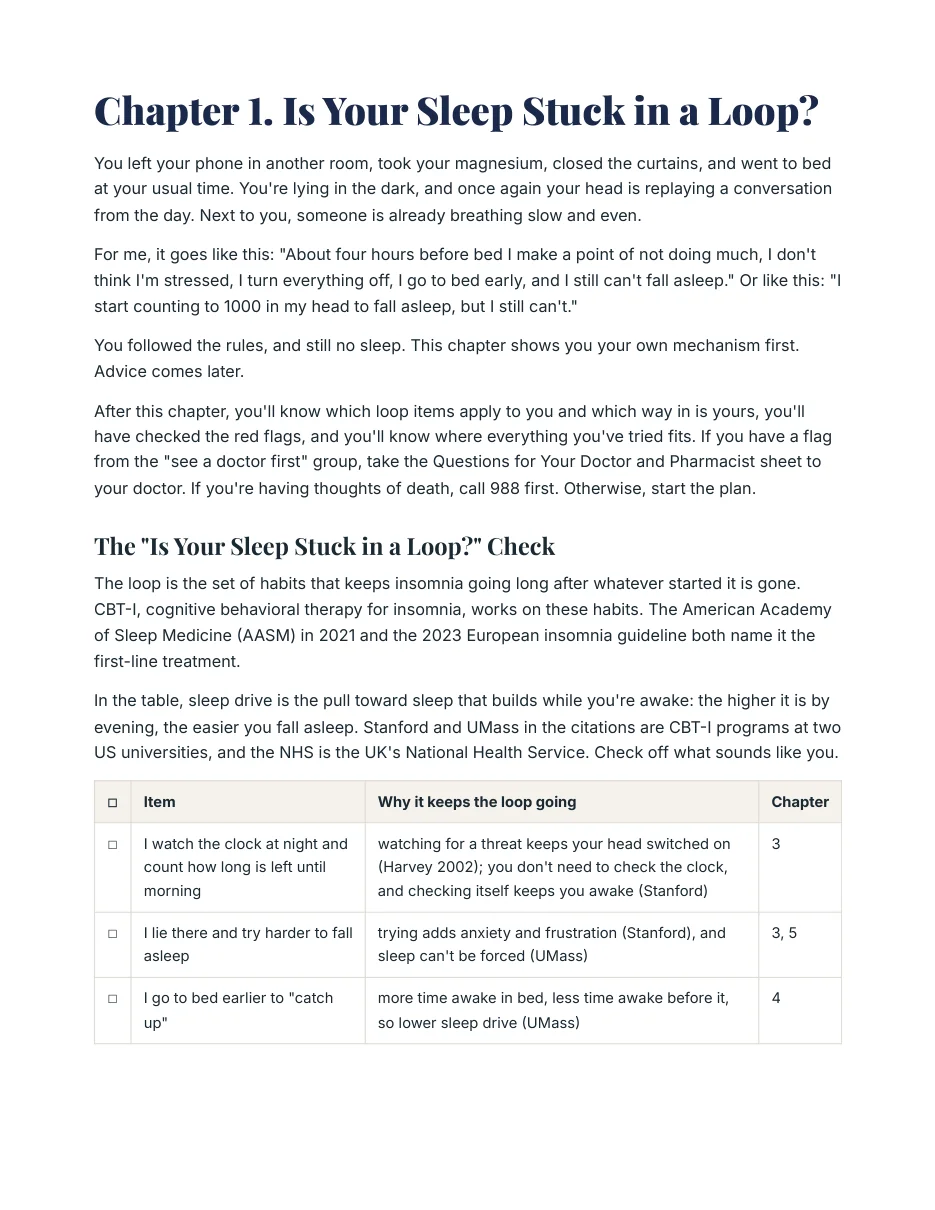
Why your mind switches on at night, minus the cortisol myth: worry about sleep, clock-watching, trying to force thoughts away.
A one-hour buffer before bed, outside the bedroom.
A "worry → next step" sheet and a 5-minute to-do list for tomorrow. Both have only been tested in small studies, and they're labeled that way.
What to do if your mind races in bed, and if a thought hits at 3am.
Answers to six night thoughts: "if I don't fall asleep now, I'll blow everything tomorrow," "one night like this wrecks my health," "something is seriously wrong with me," "it'll always be like this," "I need to try harder," "everyone's asleep but me." Each gets a calm answer with a source, and an action.
Two relaxation practices with step-by-step scripts: first during the day, then before bed. 4-7-8 breathing is offered as relaxation, with no "falling asleep in 2 minutes."
If it's not just about sleep: mood, burnout, and where to turn.
What you'll have after it: an evening routine for a racing mind, a rule for thoughts in bed and at 3am, ready answers to six night thoughts, and two relaxation practices to pick from.
Instead of "just don't think about sleep," you get a plan for the evening and for 3am.
06Chapter 6
Melatonin, Magnesium, 5-HTP and the Rest: Known, Debated, Myth
Answers the question: "What on my supplement shelf is real, and what's marketing?"
Another magnesium video, and that small flicker of hope again. I've taken melatonin, 5-HTP, and magnesium myself. This chapter goes through popular supplement claims, with no doses and no brands.
What's inside
A shelf audit: what you take, since when, why, and what you notice.
The labels "known," "debated," and "myth": a label goes on a claim, never on a bottle or brand, and every label has a source. Where there's no data, the book says so.
7 cards: melatonin, magnesium, 5-HTP, valerian, tryptophan, antihistamine "sleep aids," chamomile and other herbs.
What was found in melatonin gummies, and why in the US melatonin is sold as a dietary supplement, with looser regulation than drugs.
Where to be careful: don't combine 5-HTP with SSRI or MAOI antidepressants.
Trends from your feed, put through the same check: blue-light glasses, mouth taping, weighted blankets, a pressure point on the forehead, "falling asleep in 2 minutes," "the app will solve it."
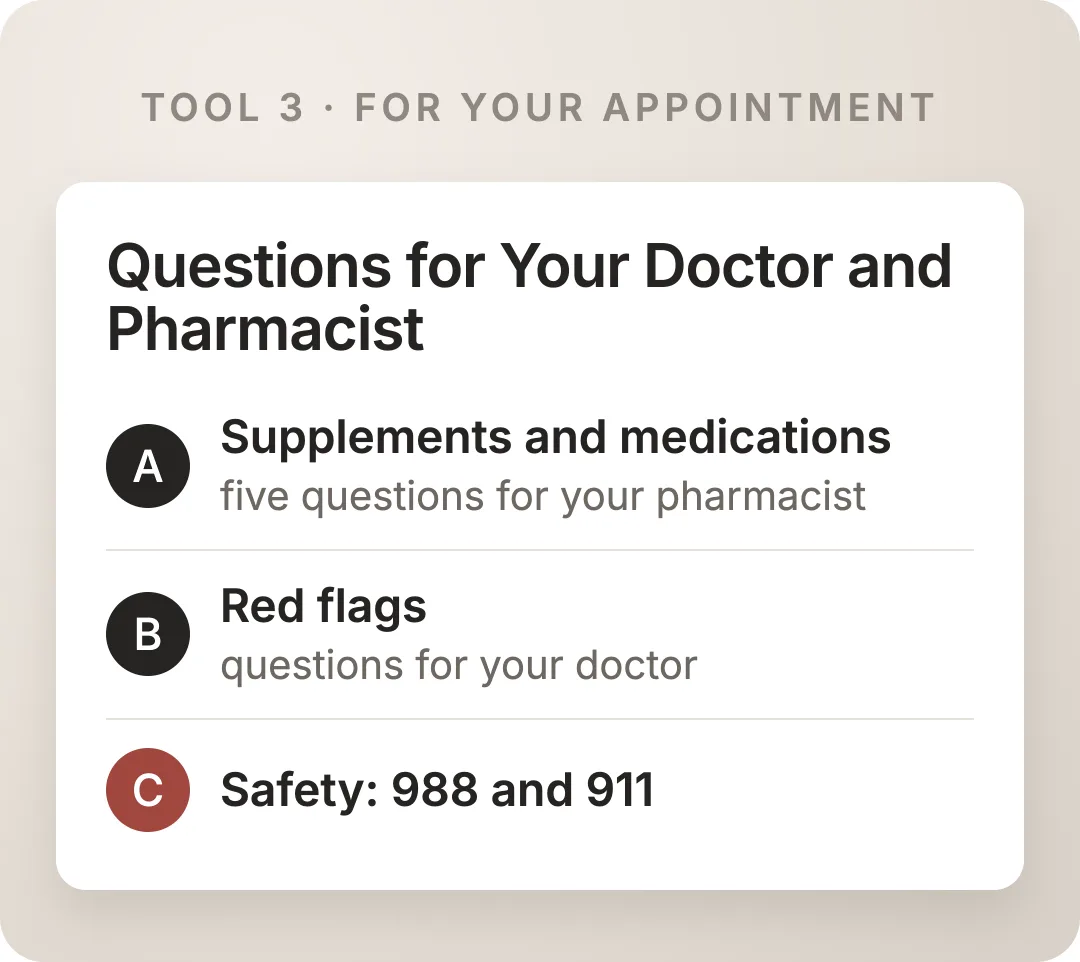
If you take sleeping pills or other prescribed medication: don't stop on your own; talk to your doctor.
5 questions for your doctor or pharmacist.
What you'll have after it: your shelf is sorted by label, you know where to be careful, and you go to your doctor or pharmacist with your own list and the five questions from the sheet.
Read it before you buy the next bottle.
07Chapter 7
Slips, Trackers, and When the Book Isn't Enough
Answers the question: "What do I do after a slip? And what if the book isn't enough?"
The morning after a night when you took melatonin "just for tonight" and decided to catch up on sleep over the weekend. Here a slip is part of the plan, and you know exactly what to do after one.
What's inside
What a slip usually looks like, and why it's worth expecting one.
A 4-point plan to get back on track the next day.
Trackers and orthosomnia: why the diary replaces your tracker's score, and why the tracker goes on pause for 6 weeks.
When things get better: why you keep your anchor.
Your 6-week summary: week 1 and week 6 side by side across five measures from your diary.
When the book isn't enough: an insomnia specialist, programs from the VA, Sleepio through your employer or insurance.
What you'll have after it: after a slip, you're back on the plan the next day, you see your 6 weeks in your own numbers, and you know your next step.
If the book isn't enough, that's not a failure: you'll walk into a specialist's office with your sleep diary in hand.
Glossary in Plain English · Sources
10 terms in plain English: CBT-I, stimulus control, sleep restriction, sleep window, sleep diary, sleep efficiency, sleep drive, sleep hygiene, orthosomnia, the 988 line. Plus a list of sources with real links, so you can open and check any number in the book.